Trading journal
Perpetual Futures Trading Journal
Journal perpetual futures trades the right way: record funding, properly track your risk, and import trades instantly from Hyperliquid.
Published · Updated · 5 min read
Journaling perp trades
The core of journaling does not change: plan, execute, record, review. The instrument does.
A perpetual future has no expiry. You never own the coin. You hold leveraged price exposure that the exchange keeps near spot with funding payments between longs and shorts. That brings costs and failure modes a stock trade does not have:
- Funding is a cash flow while the position is open. On a multi-day hold it can turn a small winner into a small loser, or pay you to stay in. Entire strategies are based on harvesting funding rate carry. This is a unique property of perpetual futures.
- Leverage on positions - anywhere from 3x to 100x depending on the venue.
- Liquidation is an involuntary exit. If you over-leverage a position and the market moves against you, the venue will liquidate your position.
- The market never closes. Perpetual futures trade 24/7. This is a huge value proposition for new assets coming onchain such as tokenized stocks and commodities.
The vocabulary that matters
Notional is quantity times price: the full exposure that drives P&L and funding. Margin is only what you posted. Your journal already has notional once it has quantity and fill price.
Leverage is notional divided by margin. Ex: $5,000 notional / $1000 margin = 5x Leverage
Funding is the payment between longs and shorts that keeps the perp near spot. When funding rates are positive, longs pay shorts; negative, shorts pay longs. Hyperliquid settles hourly; Forex Club's explainer on how perpetual futures work is an excellent walk-through of the mechanism, including a margin example from entry to liquidation.
What to record
Import the fills
- Symbol, side (direction), and every entry and exit leg with price, size, and time.
- All fees: exchange fee, any builder fee, and funding paid or received while open. Funding belongs in fees because it is a cost of the hold; when you receive it, fees go down.
- Net P&L after that.
Add what the exchange does not know
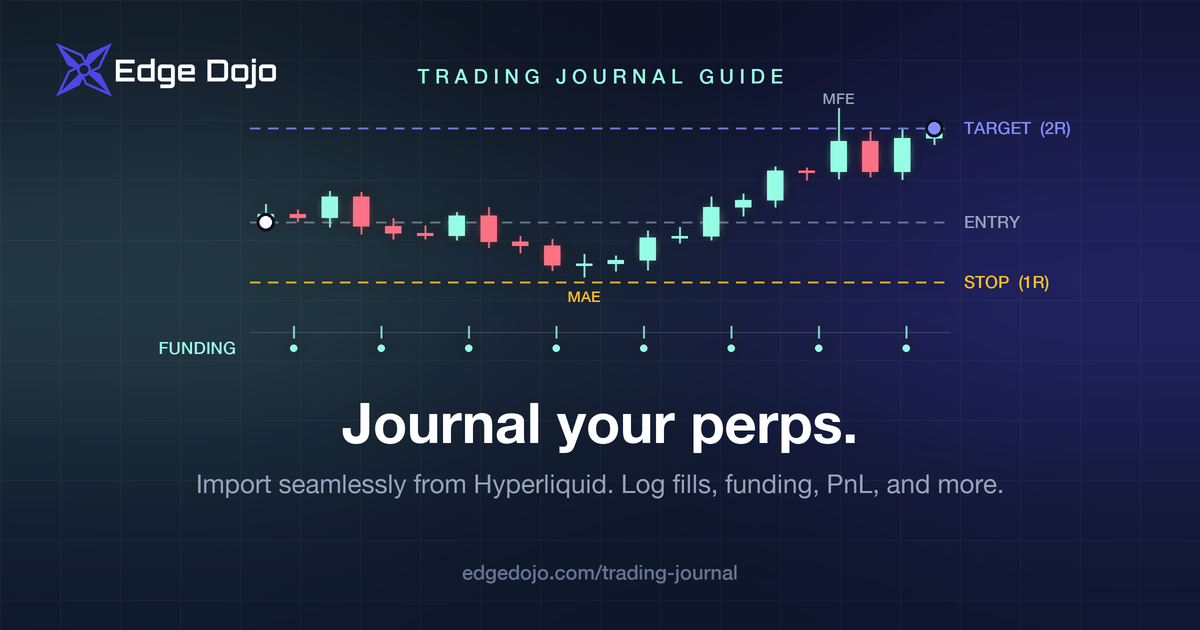
- Stop and target, set before entry, so every result becomes an R-multiple.
- Setup, as a strategy with a checklist you tick per trade. That is how you tell a good loser from a bad winner.
- MAE and MFE, to check whether stops and targets sit in the right places.
- A screenshot at entry, and ideally at exit.
- A sentence on what you were thinking.
On every session
- A short plan when your session starts: mood, conditions, catalysts, what you expect to do.
- Two or three takeaways when you decide the session is over.
- An A to F grade for how you traded, independent of P&L. Did you execute on your plan?
You don't need to use full leverage
Risk is generally entry-to-stop distance times quantity. A 20x position with a 0.4% stop risks the same dollars as a 2x position with a 4% stop. Just because a symbol has 20x leverage available does not mean you need to use 20x leverage.
- Decide the dollars you will lose if stopped. Usually one or two percent of the account.
- Measure entry to stop in price.
- Divide dollars by that distance. That is your size.
The position size calculator helps calculate this for you. The risk:reward calculator tells you whether the target is worth the stop before you take the trade.
What to look for in review
After thirty to fifty trades, ask:
Which setups pay, in R. Expectancy by strategy, not dollars or percent of margin.
What holding costs. With funding in fees, compare fees to gross P&L by hold time. Some "swing" trades are paying twenty or thirty percent annualized to hold a view spot would have given for free. Others collect funding while they wait.
When you trade well. Break results down by hour and weekday in your time zone. Profitable in the US morning and giving it back at 2am is common and easy to miss.
Process vs luck. Compare checklist-complete trades to the ones where you cut corners. Perps make it easy to get paid on a bad entry by leaning on leverage.
Getting fills in without typing
A busy perps session can mean forty fills across a few scaled orders. Logging this all by hand is tedious.
For Hyperliquid, we make this as seamless as posible. Paste a wallet address, pick a date range, and fills sync as paired trades with P&L and fees, including builder fees and funding payments. No API keys, no signing. Re-run after each session; duplicates are skipped and open positions keep accruing funding. Details on the Hyperliquid integration page.
After that, follow how to use EdgeDojo to make sure you are getting the most out of your journal: stops and targets, strategies and checklists, tags, screenshots, and the daily diary.
Frequently asked questions
Should I journal spot and perps together? Yes, same account, tagged so you can filter. Spot often quietly hedges or doubles your perps bias.
Do I need funding on intraday trades? Only positions open at settlement pay or receive. On Hyperliquid that is hourly, so a two-hour trade may see one payment and the sync picks it up.
How do I compare 5x to 50x? In R. Set stop and target on each trade. Percent of margin is meaningless; dollars only work if planned risk was the same.
If I record only one thing today? The stop you intended at entry. R-multiples, excursion, and oversized-position checks all start there.
Start journaling your perps
EdgeDojo is free during open beta, no card required, and accounts created during the beta keep free access when paid plans launch. Paste a Hyperliquid wallet or upload a statement and your dashboard is a few minutes away. Join the free beta.
More trading journal
Trading journal
How to Use the EdgeDojo Trading Journal
EdgeDojo is best-in-class trading journal software that gets your trades in fast, asks for the few details that change how you trade, and shows you the patterns. No bloated workflow. No features you do not need. This guide shows the setup and what is worth measuring. If you are new to journaling, start with [what a trading journal is and why it works](/trading-journal/what-is-a-trading-journal).
· 13 min read
Trading journal
The Trading Journal Built to Make You Better
Guides on what a trading journal is, how to use EdgeDojo, and how to journal stocks, futures, options, crypto, and forex.
· 1 min read
Trading journal
What is a Trading Journal?
A trading journal is a record of every trade you take, along with the context around it: why you entered, where your stop and target were, how the trade behaved while it was open, and what you were thinking and feeling at the time. A journal shows you the data, and is a crucial tool for any serious trader who is trying to improve.
· 10 min read